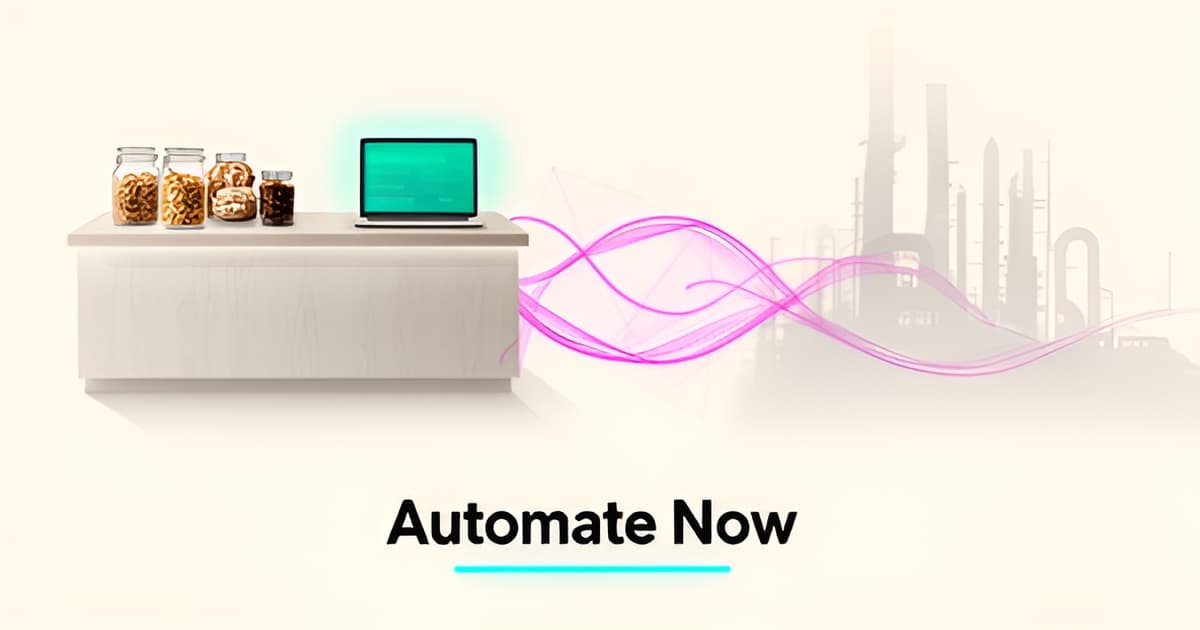
The headlines are full of bold claims: AI-powered robots will soon run factory floors, handle delicate food prep, and replace human workers on the line. But for the small restaurant owner, the busy café manager, or the regional food distributor, those promises feel distant. The reality, according to recent industry reporting, is that full autonomy on the factory floor is still a decade away. Meanwhile, the business side, missed calls, unanswered quotes, stale websites, reviews that never get requested, is bleeding revenue today.
Key points
- Enterprise food manufacturers face a decade-long wait before physical AI robotics achieve full autonomy on the factory floor.
- Small food businesses cannot afford to wait, they need lead follow-up, quote generation, and content running now.
- AI Business Sites builds and runs a complete AI-powered business presence, including website, chatbot, CRM, and content engine, live in seven days.
- The platform's Jobs & Estimates module closes the quote-to-invoice loop automatically, a feature competitors charge per-seat subscriptions for.
- One flat monthly price includes everything, online selling, SEO content, review management, and meeting scheduling, with no per-seat fees or technical projects for the client.
A recent FoodNavigator article framed the near-term outlook for AI in food and beverage as increasingly automated "pockets" within production facilities rather than fully autonomous factories. Richard Smith of Newtech Intelligent Automation calls this next frontier "physical AI", robotics capable of picking delicate items, performing quality inspection, and even executing complex cuts. The timeline: years of integration, testing, and refinement before anything approaches autonomy at scale. For a small business, a decade is too long to wait. The pain is immediate. A restaurant that doesn't answer the phone after 5 PM loses calls to the next business on Google. A catering company that can't draft a quote in minutes sees the client go to a competitor. A café that doesn't publish fresh content fades from local search. These aren't problems for a future AI; they're problems for today's business.
The same themes the FoodNavigator piece outlines, reduced downtime, less guesswork, labor relief, predictive supply chains, personalized consumer engagement, map directly to the operational challenges of a small food business. The difference is scale and timeline. A food manufacturer worries about integrating AI across a 200,000-square-foot facility. A regional distributor worries about losing a call while on a job site. The enterprise faces integration costs and governance boards; the SMB faces missed revenue and overworked staff. The good news is that the AI capabilities small businesses need are already here. They don't require a factory-scale rollout or a team of data scientists. They require a done-for-you system that handles the back office so the owner can focus on the trade.
AI Business Sites builds and runs a complete AI-powered business presence. It is not a website builder and it is not a SaaS toolkit the client must operate. It is a done-for-you AI business operating system. For a one-time setup fee (currently waived under the current offer) and a monthly subscription, the client gets a custom website plus an AI back office that includes a chatbot, CRM, content engine, automations, and reports. The website launches with 85+ pages live in seven days. The monthly fee includes 14+ new SEO pieces per month, daily industry news, 24/7 chat and voice on the site, a Jobs & Estimates module that closes the quote-to-invoice loop, online selling capabilities, and meeting scheduling with an AI notetaker whose summary lands in the CRM. The client owns everything, code, content, data, domain, and can cancel anytime with no contract.
One of the most immediate pain points for any food service business is the quote. A client calls, wants to know the cost, and waits. If the business doesn't respond quickly, the client moves on. AI Business Sites includes a Jobs & Estimates module that automates this loop. From the initial call or chat, the AI can draft a line-item quote. The customer approves it online with a typed e-signature. That approved quote becomes a job card on the calendar. The invoice goes out, collects payment via the client's own Stripe account, and a review request follows automatically. Competitors in the field-service space charge per-seat subscriptions for features that are included here. There are no per-seat fees, no add-on gates for reviews or e-signature, and no technical project for the client to manage. It runs on autopilot.
The FoodNavigator piece notes that generative AI enables personalized marketing, tailored product recommendations, and real-time responsiveness to consumer preferences. For a large brand, this requires a data science team and significant budget. For a local restaurant or café, it requires a different approach. AI Business Sites includes a content engine that publishes 14+ new SEO pieces per month, blog posts, service pages, location pages, and comparison guides. Each piece is keyword-targeted and written by a pipeline of 12 specialized AI agents. The engine also generates AI featured images for every page, wired into Google Discover optimization. The client doesn't write the content, doesn't manage the pipeline, and doesn't need to understand the technology. They simply receive fresh, relevant content that helps them show up when potential customers are searching.
Physical AI on the factory floor may still be years away, but the AI small businesses need today is here. AI Business Sites delivers a complete, running AI back office, website, chatbot, CRM, content engine, quote-to-invoice loop, live in seven days. It is one flat monthly price, no per-seat fees, no technical project for the client. The enterprise may wait a decade for fully autonomous factories; a small food business can have a fully operating AI-powered presence today.